IMPORTANCE OF PROOFREADING
Have you ever read an interesting book or the morning newspaper and come across a sentence that confused you and made you stop to think about its meaning? Consider a few real-world blunders: • The accidental letter: "The chef prepared a special soup for the pubic." (A missing l turns public into an embarrassing disaster.) • The dangerous comma: "Let’s eat, Grandma!" becomes "Let’s eat Grandma!" (One tiny comma makes the difference between sharing a meal with your grandmother and turning her into dinner!) • The wrong sound-alike word: "The principal told the students to keep their piece." (A student might want peace and quiet, not a piece of cake.) • The missing hyphen: "We saw twenty four-foot ladders." versus "We saw twenty-four foot ladders." (Are there twenty tall ladders or twenty-four small ones?)
PROOFREADING Have you ever read an interesting book or the morning newspaper and come across a sentence that confused you and made you stop to think about its meaning? Consider a few real-world blunders: • The accidental letter: "The chef prepared a special soup for the pubic." (A missing l turns public into an embarrassing disaster.) • The dangerous comma: "Let’s eat, Grandma!" becomes "Let’s eat Grandma!" (One tiny comma makes the difference between sharing a meal with your grandmother and turning her into dinner!) • The wrong sound-alike word: "The principal told the students to keep their piece." (A student might want peace and quiet, not a piece of cake.) • The missing hyphen: "We saw twenty four-foot ladders." versus "We saw twenty-four foot ladders." (Are there twenty tall ladders or twenty-four small ones?) • The sneaky repeated word: "The boy walked into the the classroom." (Did your eyes jump right over the double the? Most readers miss it on the first glance!) In a single second, the magic breaks. Instead of enjoying the story or following the news, your brain gets stuck on the mistake. You pause, read it again and wonder: How did nobody notice this before printing thousands of copies? These are the kinds of proofreading mistakes that can turn an ordinary sentence into an embarrassing blunder, change the meaning of a message or even make readers burst into laughter. A misplaced comma, a confusing sound-alike word, a missing hyphen or a repeated word may seem like a tiny error, but in a printed book, newspaper or online article, it can damage the writer’s credibility and distract readers from the message. That is why proofreading matters as it catches the little mistakes that can make a big difference. WHAT IS PROOFREADING? Proofreading is the process of carefully checking a document, usually at or near the final stage, to identify and correct remaining errors before publication, printing, submission or release. A proofreader may check Spelling, Typographical errors, Grammar, Punctuation, Capitalization ,Missing words, Extra words, Incorrect word forms, Spacing, Headings, Page numbers, Captions, Numbering, Formatting ,Consistency, Names, Dates, Numbers, References etc. Historically, the term derives from the "proof" (a trial print or typeset layout produced by a press). The editor or reader examined this proof sheet against the original copy to catch typesetting slips, mechanical faults and layout discrepancies before the final print run began. In modern digital publishing, it functions as the ultimate quality check to ensure a text is mechanically accurate, visually cohesive and ready for readers. Proofreading is the systematic process of reading a formatted text to detect, mark and correct surface errors in spelling, punctuation, grammar, typography and visual layout. According to The Chicago Manual of Style, proofreading is usually the final editorial stage of preparing a manuscript for publication. It involves a meticulous read-through to check for technical errors, style adherence and internal consistency, as well as marking or electronically coding the text so it is ready for typeset. Cambridge Dictionary defines the proofreading as the process of finding and correcting mistakes in text before it is printed, put online or finalized. Proofreading is usually carried out after the main editing has been completed. A typical publishing process may look like this: Writing → Editing → Copy Editing → Formatting/Typesetting → Proofreading → Publication However, the exact process can vary according to the type of document and the publishing organization.
WHAT HAPPENS WITHOUT PROOFREADING? Proofreading is an important step in preparing any written document for publication. Without proofreading, a document may contain spelling mistakes, grammatical errors, incorrect punctuation, formatting problems and factual inconsistencies. Even a well-written piece of content can lose its quality and effectiveness if these errors remain uncorrected. Proofreading helps ensure that the final text is accurate, clear, professional and easy to read. 1. Spelling and Grammar Mistakes Remain Without proofreading, spelling mistakes, incorrect verb forms, subject–verb agreement errors and other grammatical problems may appear in the final document. These mistakes can confuse readers and make the writing difficult to understand. For example, the sentence “She talk to her friends” is grammatically incorrect. The correct sentence is “She talks to her friends.” A proofreader identifies and corrects such errors before publication. 2. The Meaning of Sentences May Change Incorrect punctuation or missing words can change the meaning of a sentence. For example, “Let's eat, Uncle!” invites Uncle to eat, whereas “Let's eat Uncle!” suggests something entirely different. Without proofreading, such mistakes may remain in books, articles, advertisements and other written materials, sometimes creating confusion or unintended humour. 3. The Document May Look Unprofessional A document containing inconsistent fonts, uneven spacing, incorrect page numbers, misplaced headings or poorly arranged paragraphs may look unprofessional. These problems can reduce the visual appeal of a book, report or other publication. Proofreading helps identify such layout and formatting issues and ensures that the document follows the required design standards. 4. Readers May Lose Trust
Readers expect published material to be accurate and carefully prepared. When they repeatedly encounter errors, they may begin to doubt the quality of the content and the credibility of its author or publisher. In educational books, examination guides and reference materials, even small errors can affect a reader's understanding of important information. 5. Publishing Costs May Increase Errors discovered after publication can be expensive to correct. Publishers may need to revise digital files, reprint books, replace defective copies or issue corrected editions. Proofreading before publication reduces the likelihood of such problems and helps save time, money and effort. 6. Important Information May Be Missing During typesetting or formatting, words, sentences, paragraphs, tables or captions may accidentally be deleted, repeated or placed incorrectly. Without proofreading, these problems may go unnoticed, making the document incomplete or difficult to follow. In fact, without proofreading, even carefully written and edited content may contain errors that affect its accuracy, appearance and credibility. Proofreading is therefore essential for maintaining quality, protecting the author's reputation and delivering a reliable, professional document to readers.
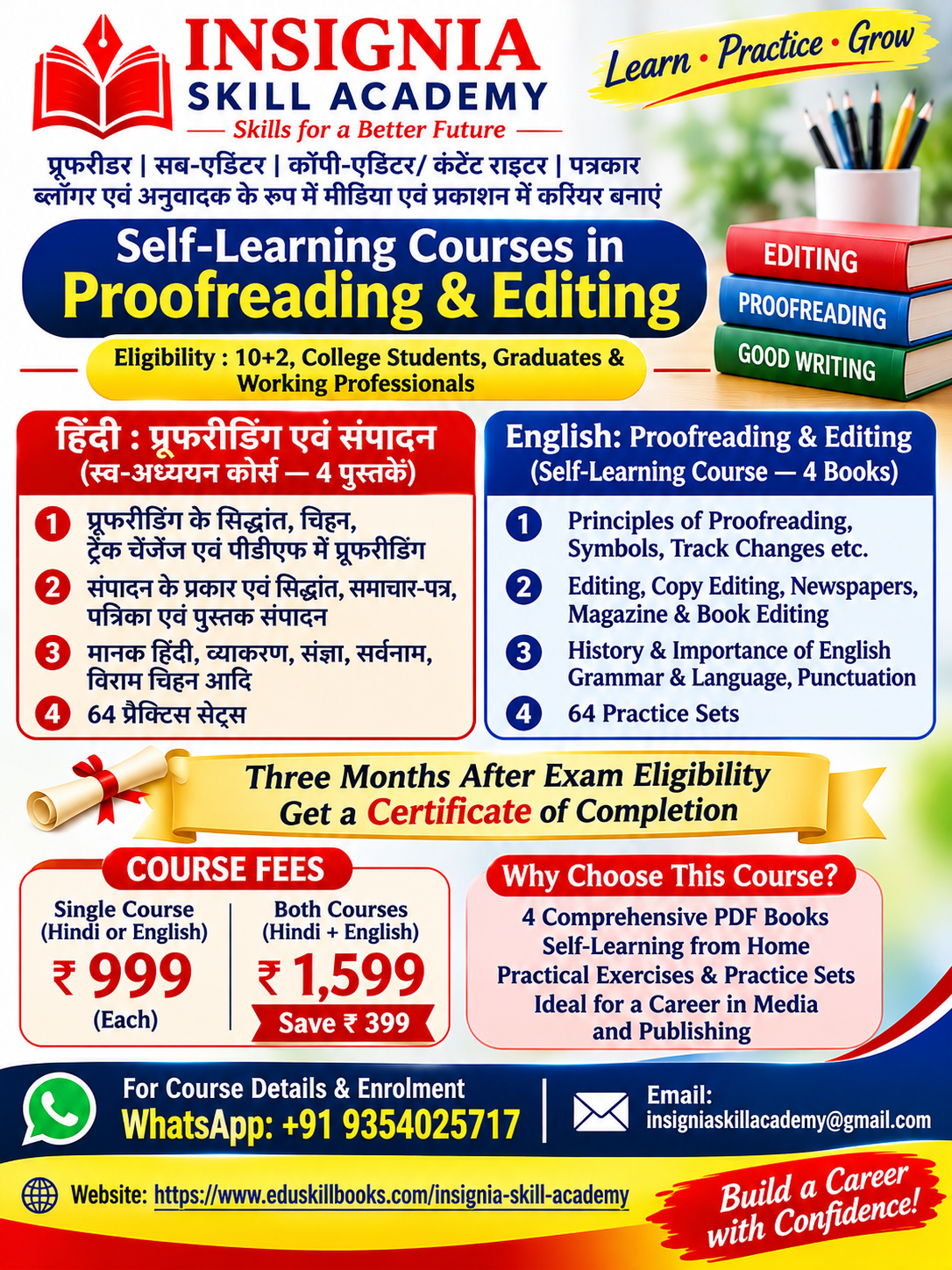
Ready to Learn Proofreading & Editing? Learn Hindi or English Proofreading & Editing from home with four comprehensive PDF books and 64 practice sets in each course. https://www.eduskillbooks.com/insignia-skill-academy